Graph representation learning
Learning text representations with inductive GNNs
How do graph architectures change the way individual documents are represented and classified?
Conference paper · IEEE ASSIC 2022 · 2022 · Co-author
Published conference paper: IEEE ASSIC 2022. An author preprint is also available through EasyChair.
My contribution. I conducted this work during my research role at LBR Research Labs, comparing TexTING, inductive GCN, and inductive GAT for document classification, and co-authored the IEEE ASSIC 2022 paper.
01 / THE QUESTION
Background.
Corpus-wide text graphs couple document representation to a graph of the entire collection. Inductive approaches instead build a separate graph for each document, making document-level representation less dependent on the complete corpus graph.
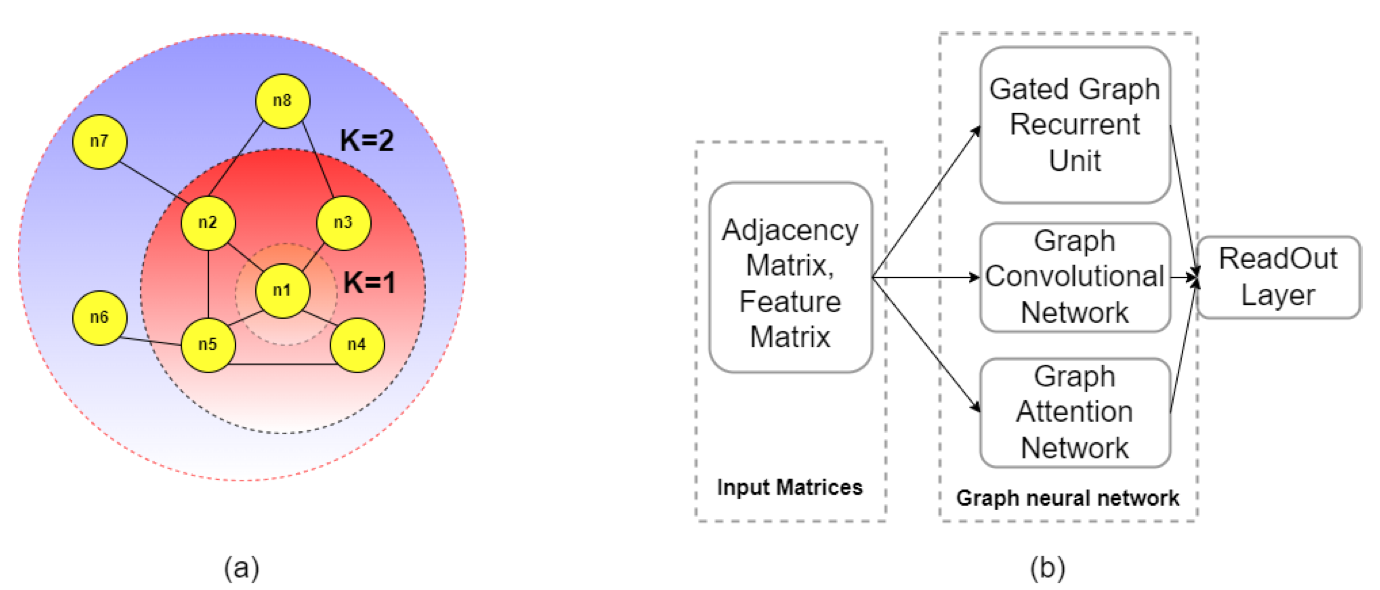
Building on TexTING, this study compares gated graph recurrent units, graph convolution, and graph attention under a common document-graph pipeline. It also examines message-passing depth and learning behavior across datasets of different sizes.
02 / THE APPROACH
Method, step by step.
Open a step to explore the approach.
01Construct a document graph
Each unique word is a node. Word co-occurrence within a window of size three determines adjacency, and 300-dimensional GloVe vectors initialize node features.
02Compare graph encoders
The study evaluates the TexTING gated graph recurrent model, an inductive graph convolutional network, and an inductive graph attention network. Attention learns the relative importance of neighboring nodes.
03Read out a document representation
The shared readout uses learned feature transformations, mean pooling, and max pooling to create a document vector, followed by softmax classification.
04Evaluate accuracy and training behavior
We compared classification accuracy and cross-entropy on AG News, IMDB, and DBpedia, examining model architecture, dataset size, and one-to-four-hop message passing.
Study design
We tested on AG News (news classification), IMDB (sentiment classification), and DBpedia (ontology classification). Models used GloVe word features, a co-occurrence window of three, Glorot initialization, and the Adam optimizer. Accuracy is shown as a percentage.
03 / THE EVIDENCE
Results.
Inductive GAT achieved the highest accuracy of the three models on every benchmark. Select a dataset to compare the results.
AG News · four-class news classification
Accuracy from Table II. Inductive GAT improves on TexTING by 0.3 percentage points.
Accuracy · scale 0–100%
0 100
| Model | Accuracy |
|---|---|
| TexTING | 91.1% |
| Inductive GCN | 91.2% |
| Inductive GAT | 91.4% |
IMDB · binary sentiment classification
Accuracy from Table II. Inductive GAT improves on TexTING by 1.1 percentage points.
Accuracy · scale 0–100%
0 100
| Model | Accuracy |
|---|---|
| TexTING | 86.7% |
| Inductive GCN | 86.6% |
| Inductive GAT | 87.8% |
DBpedia · fourteen-class ontology classification
Accuracy from Table II. Inductive GAT improves on TexTING by 1.4 percentage points.
Accuracy · scale 0–100%
0 100
| Model | Accuracy |
|---|---|
| TexTING | 96.7% |
| Inductive GCN | 98.0% |
| Inductive GAT | 98.1% |
Numerical results: Pandian et al., IEEE ASSIC 2022, Table II.
04 / WHAT IT MEANS
Conclusions.
- Learned attention gave the best accuracy among the three document-level graph architectures we tested.
- We observed different early training cross-entropy behavior on IMDB and DBpedia as model complexity and dataset size changed.
- Global attention and comparisons with transformer models are directions for further study.
Limitations & next steps
Our experiments compare three graph architectures across three datasets. Transformer baselines and formal uncertainty-calibration evaluation would extend this comparison.
05 / READ FURTHER
Citation & sources.
Comparative Study of Inductive Graph Neural Network Models for Text Classification
IEEE ASSIC 2022 · International Conference on Advancements in Smart, Secure and Intelligent Computing · pp. 227–231
Citation
Pandian S, Chaurasia U, Ranjan S, Saxena S. Comparative Study of Inductive Graph Neural Network Models for Text Classification. 2022 International Conference on Advancements in Smart, Secure and Intelligent Computing (ASSIC). 2022:227–231. https://doi.org/10.1109/ASSIC55218.2022.10088315
Published conference paper: IEEE ASSIC 2022. An author preprint is also available through EasyChair.